
Coach's Corner
First Interim Report

As I mentioned in the introduction to this Silk Road blog, I am working with my cycling coach, Andrew Randell, to assess the impact of this kind of endurance cycling on an older cyclist. Andrew is able to track such metrics as my power output (I am using the Assioma power meter pedals), heart rate, and cadence. I also plug in information on rate of perceived effort, terrain, wind and weather conditions and so on. I am essentially the lab rat in this investigation.
Here is Andrew’s first interim report on his findings. If you have questions about any of this let me know in the comments section and I’ll pass them onto Andrew.
In the roughly four years that I have known him Tom has conquered North and South America on his bike, previously did a trip in Africa, and is in the process of working his way through the Silk Road. I have always wondered what sort of riding was happening on these rides, what the toll was, and how his body handled the work.
I am excited, as this time he is riding with power pedals and a heart rate monitor, so we will have data to see what is happening. I am expecting that this is going to blow up the analytical software. Let’s jump in and see what the data shows us.
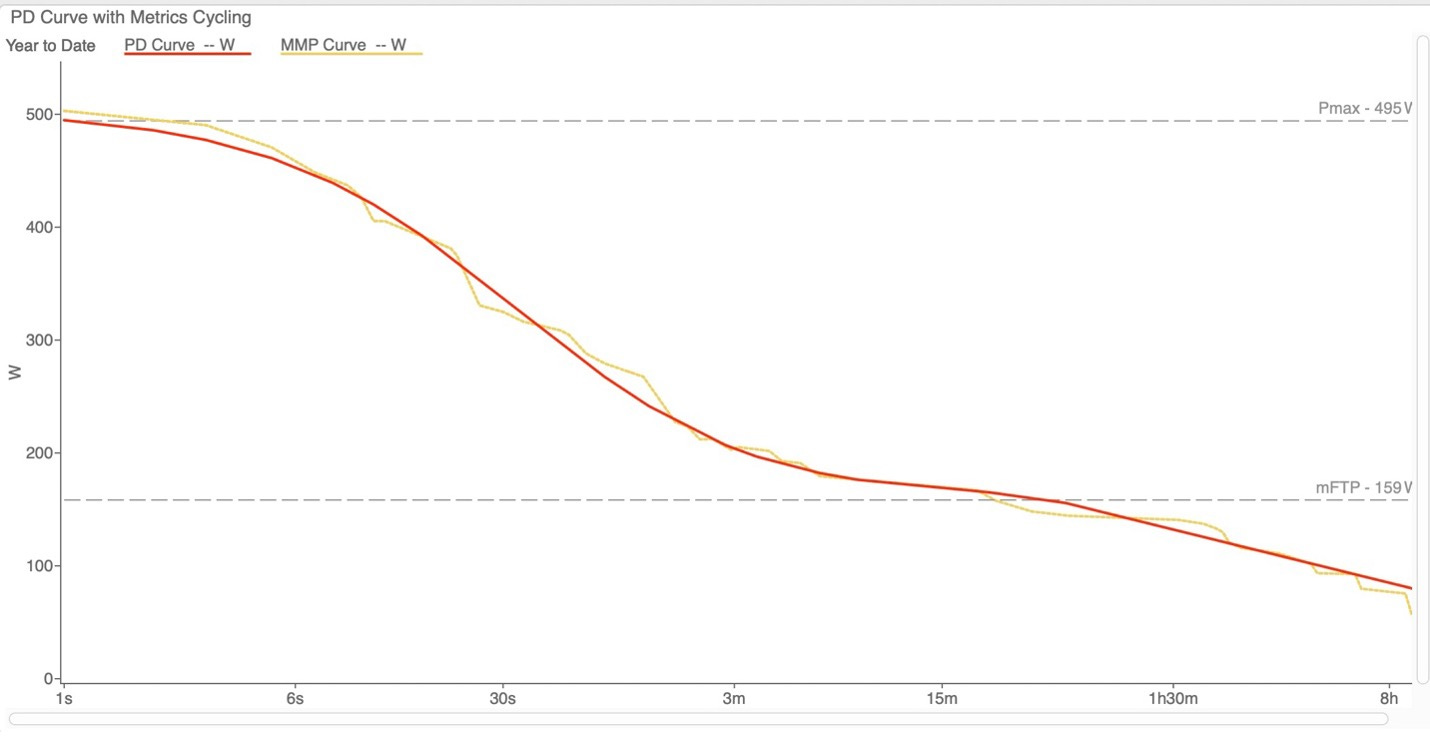
An important element to keep in mind with training is the relationship between time and power/effort. The longer you go, the lower the power or effort must be. This is nicely illustrated in what is known as the power duration curve. Note how as the time for an effort gets longer on the non-linear x-axis the power you can sustain drops off.
We can also see this principle illustrated in the aerobic and anaerobic scores ascribed to Tom’s riding. What is interesting here is how the aerobic scores for his rides increase once he starts the trip, and his anaerobic scores decrease. As he puts in more time on the bike he needs to better manage his efforts.
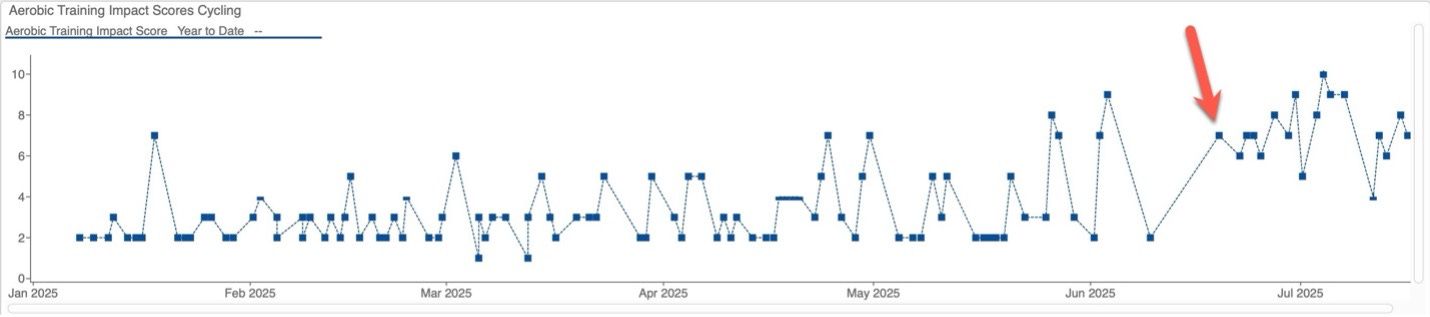
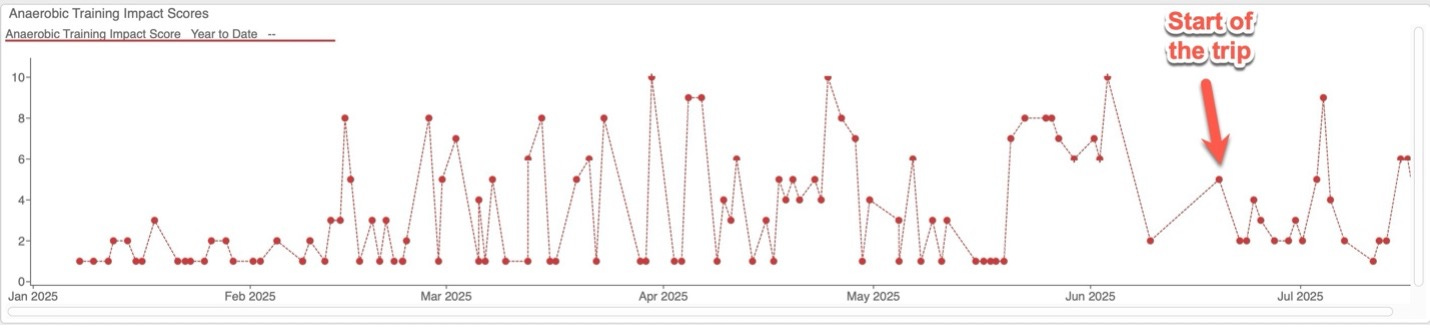
When Tom was training at home before the trip he had normal training time availability of ~10-15hours/week, with his longest rides in the range of 5hours. When you are spending this sort of time on the bike you need some of that anaerobic stimulus to try and make changes to your fitness.
Now on the Silk Road Tom’s rides are all between 4 and 7 hours in length, with his weekly hours in the first two full weeks being 35 and 37 hours each. Once you start to put in that sort of time the fatigue penalty of doing anaerobic efforts becomes too high, and so all the riding becomes very controlled.
Speaking of fatigue, this was one of the aspects of these trips that interested me most. Here we can see the Performance Management Chart (PMC) for Tom since he started training again mid-January. The more the bars drop below zero the more fatigue they represent. Note how quickly once he starts the trip his training load reaches the overload range, and how many days he has already been there. The question is how sustainable is this?
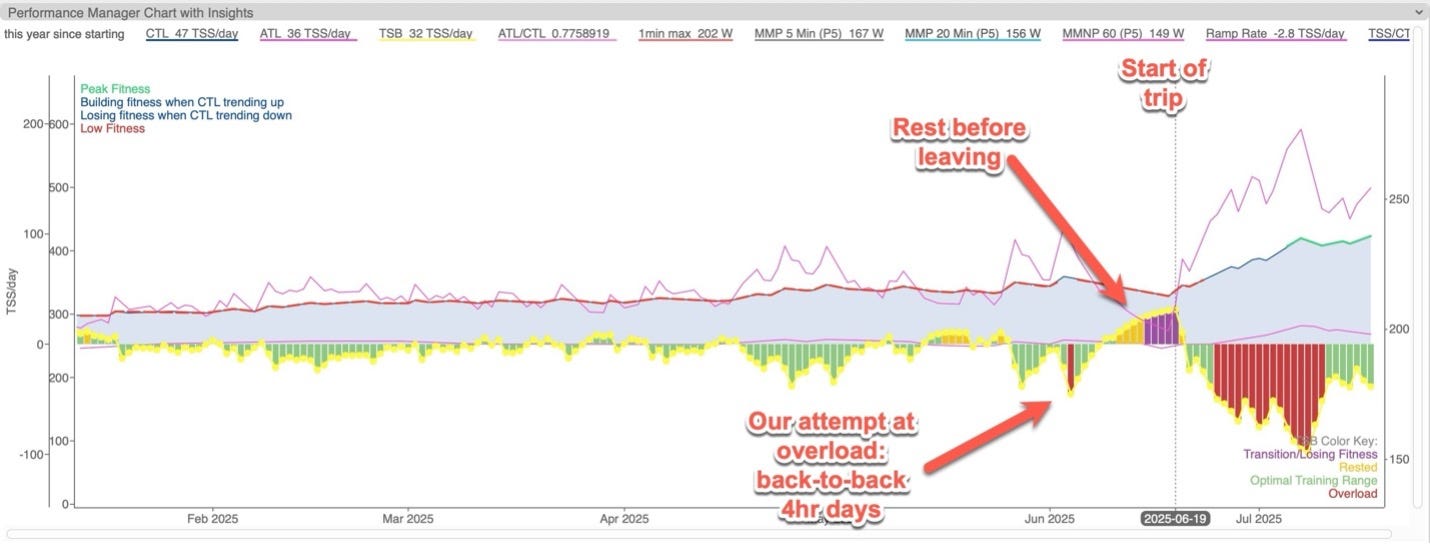
If we take a closer look at the training load once the trip starts what we do notice is how quickly it builds, illustrated by the Acute Training Load (ATL – pink line). In training we are always looking to work within a sustainable range, we want to challenge the body without creating too much fatigue. Here you can see that after two weeks the ATL/CTL ratio is 2.02, very high! This ratio is comparing the short term training load (ATL) to the longer term load (CTL – chronic training load) to give us insights into whether it is sustainable. Anything above 1.4 is considered a warning sign that there is a high potential for some sort of setback, like getting sick or an injury. You can’t stay in an overloaded state all the time.
This final chart is also trying to look at how sustainable the training load is, based on how quickly that load is building. Notice how far above the upper alert line the load has gone. Again, you can’t stay there forever. Luckily on the trip they had three rest days after the training load peaked. As that happens we see that training load diminishing.
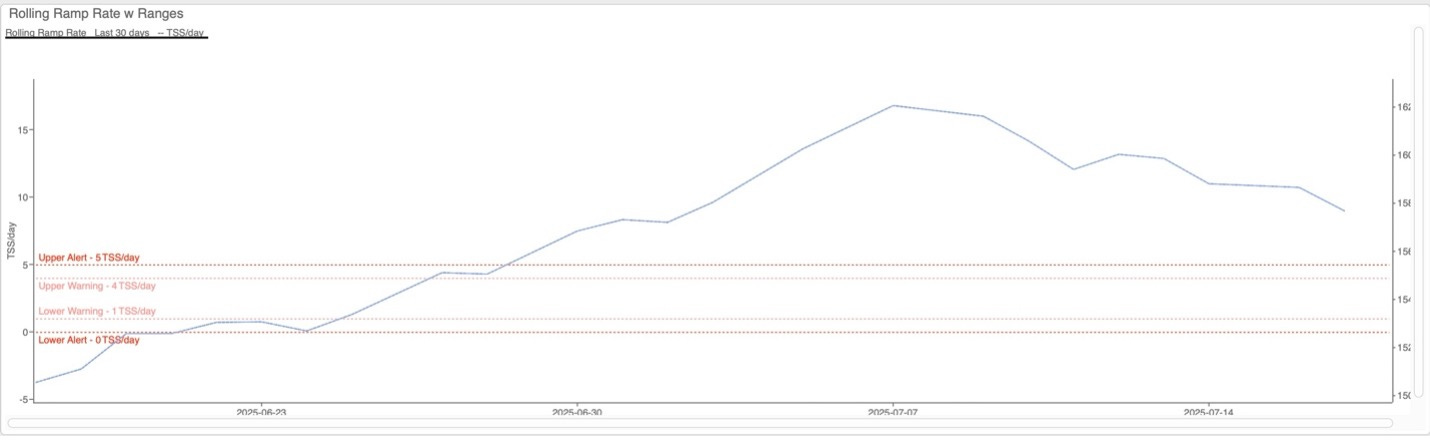
The real challenge on a trip like this is managing how much work you can sustain, day over day. Already, two and a half weeks into the trip, we can see that the high load is pushing the boundaries of what is typically considered doable.
In reality though the great thing about these sorts of trips is that you don’t always have the luxury of choosing how much work you do each day. You have to get to your next night’s accommodation and perhaps there are some mountains on the route to get there.
Our next post we will revisit how Tom has managed to manage his energy, and what that might look like on any given day.
I wish I was nerdy enough to understand what he’s saying. My interpretation: Tom is a beast 🚴